

The Open Door Podcast
Heritage Without Borders: Global Lessons for Conservation at Home
Season 5, Episode 2 - Transcript
Transcript: Heritage Without Borders: Global Lessons for Conservation at Home
Season 5, Episode 2
February 27, 2026
Episode Citation:
Felicetti, Theresa & Linzel, Jessica. "Heritage Without Borders: Global Lessons for Conservation at Home." Produced by Sara Nixon. Presented by The Brown Homestead. The Open Door. 28 February 2026. Podcast, MP3 audio, length: 00:44:38.
https://thebrownhomestead.ca/open-door/s5e1-how-the-grinch-stole-christmas
[INTRODUCTION]
[00:00:08] ANNOUNCER: Welcome to The Open Door, brought to you by The Brown Homestead, in the heart of the beautiful Niagara Peninsula.
[0:00:16] SN: All right, folks. The Open Door podcast is coming out of hibernation with a very special treat, an episode touching on heritage conservation and venturing abroad to learn and gain new perspective. I'm Sara from the Brown Homestead, and occasional producer and host for the podcast.
In summer of 2025, two members of the Homestead team got the chance to study heritage conservation through two separate courses in two separate countries. Jess Linzel traveled to Puglia, Italy, to take part in a two-week art conservation and restoration workshop at Messors. And Theresa Felicetti participated in the King's Foundation Summer School at Dumfries House in Scotland.
Both got to immerse themselves in craftsmanship traditions and practices, unlike what we find here in Canada. Jess was working with paintings and frescoes from as early as the 15th century. And Theresa learning even older building practices like thatching. The Brown Homestead may be the oldest home in St. Catherines, Ontario, but we're not quite that old.
Built starting in 1796, the main farmhouse we operate out of is constructed out of local limestone. Our historic site is undergoing adaptive rehabilitation. Once a small family farm over almost two centuries ago to now a vibrant cultural community space. And we work with heritage tradespeople from all over. And we share close ties to the Willowbank School of Restoration Arts nearby in Queenston, which as you'll hear, Theresa is a graduate of.
But the realities of heritage conservation practice here in Canada is inevitably different than in Italy or Scotland, not just in the history and age of materials but in the practical tradition also. Perhaps more fascinating, though, is where we find similarities in our conversations and the values at the heart of this work.
The Homestead's approach to heritage conservation has been to bring the community into the process. And it's ongoing. So, what can we learn from Jess and Theresa's summer abroad? And how can we apply the conversations being had around heritage conservation overseas to the work we're doing right here on our historic site?
Jess and Theresa recorded their conversation on a summer's day. They chose a picnic table surrounded by the historic buildings on our property. So, we invite you to sit somewhere that invites you into the past as you listen and enjoy the background sounds of nature and the odd passing car. Let's get into the conversation.
[EPISODE]
[0:03:04] JL: Okay. Hello. It's great to be here today outside at the Brown Homestead. I'm excited to have this conversation with you, Theresa, about our trips this summer. The workshop that I participated in, it's one of four different workshops that are offered through the Messors program in southern Italy, in the Puglia region. And Messors, it's an organization that supports and promotes cultural heritage.
So, their educational workshops are immersive experiences that involve participants in hands-on activities. And that's one of their big things is allowing people to try things hands-on in order to better understand the craft itself. And I took part in the art conservation workshop. This was a two-week-long immersive experience that focused on 17th to 20th century European paintings, as well as the conservation of Rupestrian cave frescoes from the 15th century.
And I should probably explain what Rupestrian sites are as well because this is something I hadn't heard about before this workshop, and it's not really a common thing that we see in Canada. Essentially, what it refers to are they're places where structures or art are carved directly into rock formations, like caves or cliffs. And these sites can be settlements, religious spaces like churches, or places with rock art. The term Rupestrian itself refers to anything related to or found in rocks.
And there was a group of 13 of us participants who signed up from all over the world, and none of us had any art conservation hands-on experience. And we explored concepts of cultural heritage conservation with a specific emphasis on fine art and fresco preservation.
So the curriculum combined theoretical concepts with practical application, which is great because I do think, like I said, a lot of theory can be applied here to what we're doing at the Homestead. And along with this, there were also seminars. These seminars helped us to better understand the historical context that we were learning about. So, iconography, technical concepts like chemistry, colour theory, inpainting. And all of this helped us to better understand the complexities of art conservation. And all of this, we were able to put it all into practice later on.
And then the course, it included some fun outings as well. So, we visited other local Rupestrian and archaeological sites. And we spent a day at Matera and a 2-day field trip in Pompei with an overnight in Naples. So, it was jam-packed, full of really exciting stuff, and it was all brand new to me. I'd never been to Italy before, so it was quite the experience.
[0:05:36] TF: That's a good first dive into Italy.
[0:05:40] JL: Yeah, I feel very grateful to have had such a great first experience.
[0:05:45] TF: Yeah, Jen and Tonio are awesome, and they really know the area. So I feel like they can immerse you in the Italian culture in a really kind of unique and significant way.
[0:05:54] JL: Jen and Tonio run the Messors workshops. And Theresa actually was able to go on one of these experiences a number of years ago. So, we're both familiar with them and the work that they do at this point.
[0:06:07] TF: This year, I went to the King's Foundation, the King's Foundation Summer School. So, I'll talk a little bit more about what that entailed. So that brings together people from all over the world who work in the built environment to learn about and engage hands-on with the myriad of traditional crafts that make up our historic spaces. It's a chance for you to step outside your own craft or discipline, gain appreciation for other crafts, and then also understand how they all really intersect with one another in our historic spaces.
If you already had a craft background but maybe haven't been working within it in the traditional sense, it also helps you see the evolution of your own craft, you can just go for the 3-week program, which is what I did. But the summer school is really kind of kicks off and is the start of a longer six or eight-month training program in the UK and for craftspeople in Ireland to help the next generation of craftspeople find work and get experience in heritage trade and conservation.
So kind of you focused on three different things, I guess, each week. So the first week was all about drawing and sketch carving, which was a type of stone carving. And you also did sacred geometry. This week, I really felt grounded me in the natural world and how it connects to our built world. For me, it really encouraged reflection on creating from nature and how to both respect and, in a way, encapsulate the natural world and what you are creating or building.
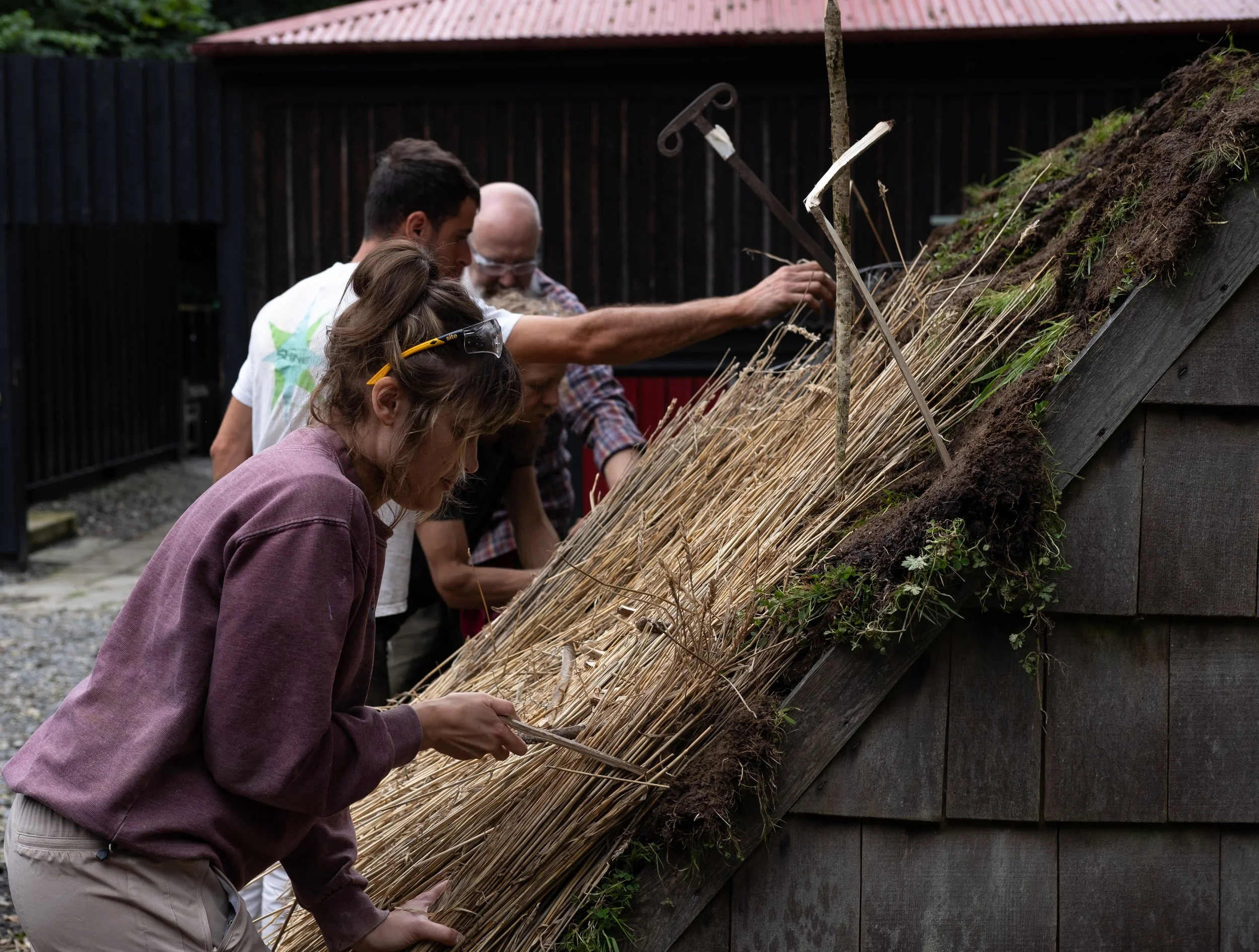
The second week was craft week. So you chose three crafts, and then you spent 2 days learning how to do each of them. So I chose earth building, which had a combination of doing kind of mud building or cobbing, thatching, and working with earth mortars. Then I also did masonry and decorative plaster. Getting hands-on is always a great opportunity because it gives you the opportunity to appreciate the skills and attention that goes into these crafts and to better understand how materials differ or require a different approach from other crafts as well.
And then week three was all about arches and Catalan vaults, which is a 600-year-old technique using terracotta tiles, plaster, and mortar. There's very little framework involved, and it really just relies on two or three materials and the power of geometry to create strong, long-lasting structures.
[0:08:25] SN: Before we go further, it's worth noting here that Canadian heritage professionals follow the standards and guidelines for the conservation of historic places in Canada. These outline three approaches to heritage conservation: preservation, rehabilitation, and restoration.
Preservation focuses on maintaining and stabilizing an existing building or material. You're not making any changes or alterations, but stabilizing the condition it's in. When a building is rehabilitated, it is adapted for current use or needs while its heritage value is protected. And when a building is restored, that means layers are peeled back or recovered to represent a historic place at a specific moment in time. Here at the homestead, we mainly practice rehabilitation.
All right, now let's hear from Jess about how the Messors program in Italy approached heritage conservation and how it compares to our practices here in Canada.
[0:09:27] JL: The whole time I was there, I was trying to figure that part out. I'm here in Italy, but how can I translate this back to what we're doing at home? And what we're doing here at the Homestead, I would say, isn't necessarily what the standard is in Canada either. So when I'm comparing, I'm comparing the Italian context to the Canadian context as well as our context.
But even the way that they think about it at Messors is different than the general Italian context because a lot of us smaller organizations have questions about methods and best practices when it comes to what the government's choice is or what institutional choice is in a lot of these situations. And so we have different perspectives, we have different thoughts.
And it was interesting because one of the lectures that they provided to us was about the difference between restoration, conservation, and preservation. Because as we know, we talk about this a lot here at the Homestead that there's a difference between the three of those. It was interesting to hear what those terms meant in an Italian context, and it's pretty similar, I would say, to how we see it in Canada. So that was nice to know that we're kind of on the same page in a lot of ways.
It was nice to see that there are people in a whole other country, other side of the world, that are thinking about these things the same way that we are. And I guess I'm curious what you thought with your program. How did you guys approach the general topic of heritage conservation? And did you find it similar to the conversations that we have here?
[0:10:54] TF: I would say that the program took a really holistic approach to understanding heritage crafts, and it really, really placed value on the craftsperson as the main pillar of heritage conservation. And I think we have that view here, definitely at the Brown Homestead, because I think you can have as many nice ideas and plans about what you want to do with a heritage site. But if no one knows how to work in these sites or with the materials, then that doesn't really matter if you can't take it out of your brain or off paper and actually know how to do it.
I think for those in the program, it really highlights how important it is to understand how different materials and crafts intersect and how they can support one another in the built environment. And it kind of made me think a little bit about, of course, we need people who are deeply skilled in one specific craft, but how valuable it is to understand other crafts as well. It allows you to make better decisions within your own expertise because you can recognize when your craft might have other limitations and when another material or approach might be a better choice. And if you've never had the opportunity to try it and be exposed to it or be introduced to other craftspeople that are working with it, then you might not ever have known that or been able to recognize that.
Yeah, the fact that it also puts all these different craftspeople and different people in the heritage field together, there's crafts people, architects, heritage conservation professionals, it's also giving you the chance to create a network. So when you need some other advice outside of your own craft, now you have people that you can go to, and it creates more of that collaborative approach to heritage conservation, which is what I think we need more of. Every place needs to be approached differently. And one person cannot have all of the answers to that.
And I think in Canada, I would say we're starting to recognize the value of this collaborative approach more and more, and starting to better recognize the value that our craftspeople hold and the generational knowledge and the importance of having a broader understanding of material and place so that we can make better decisions in heritage conservation.
We need a holistic understanding of place and all the people that make it up in order to make better decisions. And I think this program sees the importance of that. And I think we're starting to do that more in Canada.
Having gone to Willowbank, I was already taught that approach to heritage conservation. So I I do think the heritage field is going more and more in that direction in Canada. But I think what we need is more opportunities for people to learn heritage crafts and to find opportunities for craftspeople to pass on their knowledge to the next generation.
[0:13:37] JL: As you're talking about this, so what are some of those hands-on restoration, the techniques, and the building crafts that you learn?
[0:13:43] TF: I've learned that I have very soft, sensitive hands, and they definitely have office worker hands. It's been a while since I've done any kind of hands-on work. Probably since Willowbank, and when I went to Messors back in 2016, I woke up with the worst hand cramp after like 2 days of stone carving. And then another thing is I cut – when we were doing tile vaulting, I cut the tips of my fingers just from like kind of pushing the tile in.
[0:14:12] JL: Okay. Sorry. What is tile vaulting?
[0:14:15] TF: Making arched structures. And you can create these incredibly strong and beautiful structures with just three materials and an understanding of geometry. There's a lot of resource efficiency in the craft, and people are realizing that. And it's coming back because people are noticing it for not only its strength, its beauty, but also the sustainability within that craft, which is cool. So it was cool to work with really skilled people that were – with earth building, kind of what I mentioned, you're sort of showing you have everything you literally need, can be built. A structure to live in can be built completely from the earth.
And just working with natural materials to build buildings, I think it gives you this sort of deeper appreciation for the earth and what it provides to you. I think, obviously, we don't need to get into a deep discussion about resources extraction and all that environmental damage that we do. But I think when you work with this material in this slower pace, and you're working from the earth, it's hard work. It's hard work to kind of build a stone wall, build a mud wall. You feel more appreciative of it, and you want it to last longer, and you want to make sure that you take care of the world in a way that you can keep kind of having this symbiotic relationship of getting to use these beautiful natural material in a way that is long-lasting and not going to kind of end up being waste.
And then, between earth building and masonry, I also spent a fair bit of time learning about different mortar mixes. We experimented with traditional mortar mixes, like a hotline mortar, which takes a bit longer to prepare. But they have a lot of advantages over NHLs, which we also made. They are essentially pre-made mixes that come in different strengths, and they're quicker to mix, but they don't necessarily offer the same benefits or flexibility of a traditional mortar mix may give.
So, I think seeing those examples side by side and getting to try both of them and seeing the benefits of the natural traditional hot lime water mix was really important because it's kind of that reminder that efficiency can never be the main priority of heritage conservation, especially if you want to do something well and right, and that's going to have a better impact on the building that you're working with. I think it continued to confirm my belief that heritage conservation needs to be a community effort.
As I mentioned, while I think we need people well-versed in crafts, once a structure is built, I think there's several areas where we can teach community the different methods and techniques and how to care for this structure, like how to mix a mortar, how to repoint, what to look out for, how to kind of reglaze or treat your wooden windows. There's things that are easily teachable to community that can kind of take some of the stress off of just like all the crafts people if community can get more involved and taking on some of the work that isn't as specialized, I suppose, would be the word.
[0:17:16] JL: I think that's really interesting all the different things that you got to do and try. And that concept of where you said that efficiency shouldn't be the goal. I think that's really interesting because I hadn't really thought of that before. And in our modern context that's, so counter to everything we've been taught, especially since the early 20th century, and the Fordism, and Tailorism, and the production assembly lines, and how everything has to be done at maximum efficiency.
And then now you're saying that we need to go back to doing it in a traditional way because – I guess I want to know what you think about this. But if efficiency isn't the goal, then what is the goal? Just having a properly built solid structure?
[0:17:55] TF: I think there's like multiple goals. Again, I just kind of go back to like community. I think we don't build community like out of efficiency. We build community by assessing various needs and kind of working out like what the best solution is together and on a shared goal. And I think heritage sites give you the opportunity to do that. And that's not an efficient process. That takes a whole lot of time. So, it's slowing down.
I mean, I guess to bring it back into the heritage context, we talk a lot about how heritage sites are like community connection points. They're tangible things, or pieces, or places for communities to come together, learn about how did their community even come to be. And then who's this community now? And how do we use these spaces to kind of integrate all of that? And being a part of it of kind of learning how to like take care of these places and learning the crafts. The community is getting a better respect for the amount of knowledge that is inside of these buildings and respect for the people that can do it. They care more about the place kind of continuing to exist, but then they're also feeling part of the conversation and a part of it because now we're like, "How can we also make this a place that you feel you can access and can continue to grow in?" And I think we need time to be able to do that right.
And if we're thinking efficiency, it's like I guess you could just go and be like, "Okay, this is going to be this now." But like, "Who did we talk to about it? How do we integrate people? How do we make people see the myriad of interesting people and benefits of this place?" And even talk about the not so great parts, too. That takes time as well. And we need to reflect on that as well when kind of moving into the future.
[0:19:40] JL: It sounds to me like you're saying the meaning is more important than getting it done quickly.
[0:19:45] TF: Yeah.
[0:19:45] JL: And you can't cultivate meaning quickly. That's one of those things that's going to take time, plus effort, plus multiple people. And it's not efficient. But if you did it any other way, you wouldn't have the same meaning in the end.
[0:19:59] TF: Yeah. So, I think the topic of efficiency and heritage conservation could be one to explore more maybe in a future podcast. But for now, I'd like to hear a little bit more about what types of heritage crafts restoration techniques you learned during your time with me Messors.
[0:20:14] JL: The first thing, and probably my favourite thing that I got to do, was cleaning the cave frescoes. I just thought that that was so neat. So what we did was we learned how to scrape the moss and the calcium deposits, or I think they call it sulfonation from the walls. And they were slowly growing over the frescoes, because these frescoes have been here for hundreds of years. And so over time, as they're deteriorating pieces of the plaster are crumbling off the wall and then there's growth happening over top of the remaining fresco. So we're cleaning them essentially.
So, we started off with just these little picks, these little kind of toothpick-like sticks, and we're very carefully scraping the moss and everything off of the plaster. And then eventually we graduated to scalpels. And yeah, that was kind of the first step, was just to carefully clean some of the areas on the frescoes.
After doing the cleaning, we also then learned how to fill in those cleaned areas with kind of a plaster putty. So, Tonio actually made the mixture for us, but we got to take the bits of plaster and then infill that into the fresco. And then after that, we learned how to in-paint using different painting techniques. In the caves, we used a stratezio technique. You would kind of do a little bit of a background colour that was similar to the colour that it would have been originally. And then you're painting these really faint little lines very close together so that when you're far away, it looks like the same colour and it blends into the rest of the fresco, the original fresco. But then when you go up close, you can see the gaps between the lines, and you can see that that's clearly added. That's something that someone else did, and that's new. In that way, you get the impact from standing far away of, "Wow. Look at this beautiful piece of art." But then when you're up close, you can see the old versus the new a lot more clearly.
[0:22:08] TF: That's cool. I like that because I feel like sometimes we go a little bit too hard of making something so visually different when it's being added to a heritage site. I like that they're kind of finding a way where you're still getting that kind of impact of what it would have looked like, but you can easily see what's been added, which I know is a big thing in the rules of heritage conservation is making sure you can differentiate between what is old and new.
[0:22:36] JL: Yeah. In addition to the cave work that we did, we also did work in the art studio. We learned how to clean paintings. And then after that, we also learned how to remove varnish. So a lot of the time, you'll see paintings, these are 17th to 20th century European paintings. And a lot of time you'll see varnish kind of yellow over time, or there's some issue happening underneath the varnish. For whatever reason, you need to remove the varnish in order to do some sort of conservation work. And then you might add a new layer of varnish over top.
And then I also learned how to, again, infill and in paint just like we did in the caves, but now we're doing it on the paintings. So having a little bit of putty, filling in areas of loss. If there's a hole in the canvas where the paint has been missing for whatever reason, we were shown how to fill that in with a white putty again, or like a little white plaster mix, and then inpainting. And you could do that same kind of lined technique, or you can do like a pointillism technique. I actually remember doing this in grade school, pointillism. Yeah. It's literally just a whole bunch of dots like this.
[0:23:43] TF: Are you working on original paintings when you're doing this?
[0:23:47] JL: Yeah.
[0:23:48] TF: Wow.
[0:23:48] JL: Yeah.
[0:23:49] TF: Was there like nervousness from the group?
[0:23:51] JL: Oh, all of us. Yeah. We were all terrified. I think the first couple days, we kept making comments. Well, throughout the whole thing, really, just saying, "I can't believe they're letting us do this."
[0:24:02] TF: The fact that they're original adds this like level of kind of intentionality and care you want to bring to it, knowing you're working with someone's original artwork from – I don't know what they dated to.
[0:24:12] JL: They were saying between the 1600s and the 1900s. You can imagine that time span. It's kind of like what you said with the whole community approach, doing the work that's not necessarily as technical, or it doesn't have as many risks to it. If that's something that anyone can do, I think that's so neat that they let all of us just try it.
Obviously, the technical knowledge, that takes years of schooling and practice in order to know what to use, and what to do, and how to do it correctly. But it was just fun to see that all of us had the ability to do the more meticulous cleaning, and varnish removal, and stuff like that. They were talking about archaeology of paintings essentially, because there's all these different layers of history to these paintings themselves. It wasn't just the original artist painted it, and it's done. It's been to different institutions. It's been in different people's houses or in different churches. It's had work done to it maybe 300 years ago, and then maybe again 200 years ago, then maybe 50 years ago. And everybody did something a little different. And now we are part of that story. We are a new layer. This Messors workshop group of 13 girls from all over the world, we are now part of that new layer of history on this painting.
[0:25:24] SN: The core values grounded in the teachings at Messors and the King's Foundation tie closely to the Brown Homestead's. Inquiry-based, hands-on education, and the inextricable connection between past, present, and future. Understanding that history is layered, and each layer matters.
These craftsmanship and conservation skills are crucial to share and pass on if we are to preserve our tangible heritage for future generations. This was a major conversation had in these learning spaces overseas. Heritage circles around the world are very aware of the aging population of craftspeople and the necessity to engage and train the next generation.
Theresa brought up a question that her fellow students in Scotland kept returning to throughout their time together.
[0:26:15] TF: Are we creating enough opportunities for their knowledge? Whether it be through training the next generation or sharing heritage conservation practices and crafts in the broader community. How do we kind of make those connections with the current craftspeople, and the next generation, and the community for that knowledge to be passed on? You know, not to be morbid, but really before it's too late.
And I think part of the issue is again that hasn't probably really been seen as a priority for many people. I'm talking in like kind of the broader sense. We need to do more advocacy within the community for people to see the priority and continued importance of these trades, so more people go into it, to bring more craftspeople into the conversation and see what we can do to help make those connections as well.
For the Brown Homestead, I think we've been talking more and more about that need to do more community kind of advocacy and opportunity to introduce people to these heritage trades and the many benefits of them. Not just in a historic context, but like moving forward. And so I think people will start to see how that view is starting to shape our programming over the coming years to hopefully give the community more opportunity to engage in traditional craft and learn about its importance for communities, not only to conserve, like I said, our heritage spaces, but learn how these traditional skills and how heritage conservation can align with solving issues related to sustainability and good building practices. There's also recently more heritage craft trade schools being kind of closed down in Canada, too, which is scary. So that's how you can see that community understanding of the need of it is lacking.
How about for your experience? What were the types of conversations you were having around heritage conservation?
[0:28:04] JL: So it sounds like to you it was more about the conservation of the craft itself and the knowledge around the craft. And for me, there was less of that sort of conversation, but there was still similar conversations about how to get the community involved and how to spread awareness and advocacy for helping the public understand the importance of preserving these spaces.
For you, it was more preserving knowledge. But for me, I would say we talked more about the preservation of these cultural spaces, cultural heritage spaces that are important to the communities that they exist within. For us, we talk about that all the time here. That's a really common topic of discussion at the Homestead is how do we get the community around us here in Niagara to understand the value of this place in particular, but then also other heritage spaces in Niagara, in Ontario, in Canada.
[0:28:56] TF: I think the two go hand-in-hand between like what I was talking about. We need people to kind of see the value in these places and what they bring to their community. And when they see that, they'll also realize the value in having the people that can do the work.
[0:29:08] JL: And so in the Italian context, we had a big discussion about how to preserve and educate communities about the rural Rupestrian sites, like the cave fresco sites. And then we kind of debated the different benefits and the drawbacks of, for example, leaving a deteriorating or an abandoned cave fresco site in situ, and then spending maybe the time, and effort, and money to restore and conserve it. And then maybe try and bolster tourism around it, bring people, bus to the site or whatever, the site where it was originally created. And where the artists meant for it to be experienced originally. That is one option. So, we talked about that.
Or what about if you would take that artwork, take that fresco from the deteriorating cave where nobody is seeing it or taking care of it, and then you take it to a museum or an institution where it can be taken care of and viewed by the public on mass. But just the only difference then is it's not in its original context. So, it loses a little bit of its meaning in that way.
And I found this conversation really interesting because we do have conversations like that here at the Homestead a lot. Essentially comes down to what is the point of restoration or conservation. Because no matter what, the thing will never be brought back to the way it was originally. So if that's what people want to do with it, well, it's never going to happen. The second that it was finished being made, it's no longer original because it's already starting to deteriorate.
To me, I wonder where is the line drawn on that? What is the point of doing it? Is the point to have the most amount of people see it? Is the point to keep it in a good condition for as long as possible? So that would impact what the choice is ultimately. And there's so many other factors at play. You know, how much money do we have to spend on this? Where is it? Is it going to be a place that can be accessible to people? What is the interest over time? Just because there's people that care about it now doesn't mean that 50 years, 100 years from now, you're going to have the same organizations and people in place to continue the work that you started.
I would say that that wasn't definitely a conversation that tied into what we do here, and some of the same issues, and questions, and concerns that we have about what we decide to conserve/restore/rehabilitate. And why we make the choices we do?
[0:31:36] TF: I think it's so subjective. It's a site or a piece-by-piece kind of decision, I feel. And you need a lot more kind of context. I think you can't make blanket decisions about what is right and wrong in heritage conservation, because you need an understanding of the place, and the piece, and the community, and how all these factors can come into play when making a decision.
[0:31:56] JL: Another thing that I think translated between the Messors workshop and here is that often we find our rural sites are kind of everyday history sites are deemed less important than the sites that are worked on or belong to a big important – some dude that was maybe he was in politics, or he was a big businessman, or whatever, which is important definitely to share those stories. But we find that the stories of the common person aren't as prioritized. So, how do we make sure that we continue to preserve those stories so that they're not lost as well?
[0:32:33] SN: These sorts of immersive learning experiences are crucial if we want heritage conservation to hold any real weight in how we design and plan our communities. The people who work in heritage are here because we're passionate. But passion won't get us far. Creating meaningful experiences where people work with their hands and get up close to traditional crafts and practices shows that heritage isn't a fluffy concept or a nice idea. It's the tangible history built into our surroundings. Solid, foundational, material, immediate, and fragile if we don't take care of it or don't know how. This sort of education shows us what we lose when we discard our built and cultural heritage.
Messors and the King's Foundation, Willowbank, and even what we're working towards here at the Homestead, these open up a new world for learners. Introducing skills directly connected to practitioners of the past, fostering appreciation for art and architecture, sparking curiosity and deep learning, exploring new perspectives, and inspiring a new wave of craftspeople, practitioners, and advocates. This sort of work is important now more than ever.
Jess and Theresa wrapped up their conversation by bringing these ideas back to a local context. And they discussed some of the more immediate issues facing heritage conservation here in Ontario and how their lessons from overseas have shaped their considerations.
[0:34:12] JL: Recently, the city of St. Catherines decided not to move forward with designating a portion of the downtown as a heritage conservation district, which would have made it easier to protect a larger portion of our significant heritage structures downtown rather than designating them individually. And we'd want to designate them individually in time for the bill 23 deadline of January 1st, 2027.
And if you recall the Bill 23, that's the Build More Homes Faster Act implemented by the provincial government, I think, in 2022 or something. But after the deadline of January 1st, 2027, after that point, properties that are listed on municipal heritage registers that have not yet been designated, they're going to be removed from the list, and they can't be added to the inventory again for 5 years, which negates the purpose of the inventory in the first place. So that's a big blow.
And in addition to that, we've also recently heard about the Halton region announcing that it's closing its heritage services department. And in so doing, they're getting rid of, I think, 30,000 artifacts, all without any public consultation. And they say they're going to try and disperse them amongst appropriate groups, but that whatever they can't find a good home for is going to go up for public auction. And I just think there's so many issues with that. And it's a blow to the preservation of the Halton area's history and memory, and just a terrible precedent to set, because what other parts of Ontario are now going to think it's acceptable to get rid of our tangible reminders of our community's existence and how they came to be here? If we don't protect what we have now, it's going to be gone forever. And that's just a loss that we can't be willing to budge on. Because once we start doing that, where does the line get drawn? So, those are just some of the current things that we're dealing with.
And I think you also mentioned earlier the closing of some of the few heritage trades, schools, and programs that we have in the province. Even those are struggling. So, those are some of the current issues. And I guess the conversation that we could talk about this for hours. There's so many different things to talk about, but what is our role? I think we're heritage advocates. But I'd like to hear a little bit more about what you think we can do now with the knowledge that we have, and also maybe the knowledge that we've gained from our trips.
[0:36:31] TF: For me, I think it really comes down again to community education around heritage conservation. I can totally understand why some communities would be hesitant about an HDC, especially if they don't really know what it is. It's a new concept for a lot of people.
Often, I would say there's lots of people whose kind of picture of heritage conservation or preservation is places like Niagara-on-the-Lake, which are kind of more touristy and expensive. Naturally, there's concern about how will – if they're becoming a heritage conservation district like Niagara-on-the-Lake, how might this impact their home and their business? Is it going to become more expensive?
If you're not in the heritage field on a deeper level or parts of these conversations more, and your only examples of places that have heritage designations are museums, or house museums, or quaint tourist towns like Niagara-on-the-Lake, I think it can be easy to think that heritage designation means there's no room for the current community. That it's about freezing a place in time to protect its history at the expense of people living and working there today. And sometimes I think designation is truly made to feel that way. So we need to kind of change that perspective and approach with designation.
Again, it comes into bringing people into the conversation earlier. And if you're not taught about how heritage conservation can actually be a tool for community identity and growth, if community isn't given the opportunity to be a part of that conversation sooner, if it's just sprung on you all of the sudden, it can feel very abrupt and alarming. So, you're going to obviously have a negative reaction to that.
And it's going to continue. Heritage conservation, heritage designation is going to continue to be seen as a stifling and expensive burden. And that's tough when communities are already facing tough issues like rising food prices, there's inflation, there's a volatile job market, heritage conservation and designations can just seem like one more thing on people's plate to have to worry about, like not part of the solution.
And so I think we need more resources and ways to connect communities with knowledgeable people, and to kind of for us in the industry to reflect on what is the true impact that designation is having. And how do we make sure it can be more of a benefit to communities? We need to start to show how heritage isn't just about preserving the past. It's also about strengthening our communities, building identity, and also creating those sustainable, meaningful places for everyone, which takes time.
It takes time to bring people into the conversations, and explain things, and see what people need and want. And if we take the time to do that and we have the resources to do that, I think that kind of understanding can start to change perceptions and then turn our viewing of heritage as a perceived obstacle into more of an asset for creating communities people want to be in, and live in, and work in, and can succeed in.
Yeah, I didn't really answer the question directly, but I think it's just if we want to have the heritage sector succeed or have more people open to things being designated, we need more time and resources into dispelling myths and listening to community, and also kind of helping them see more of the benefits of heritage conservation. So that's I guess what I would say.
[0:39:46] JL: I think those are some really great answers. And those are things that have been touched on by our organization in a few different ways. Actually, Sara Nixon, our Director of Community Engagement, she published an article in our journal not too long ago about the Ontario Heritage Act and Bill 23. And just often we say, "Okay, we know what the issues are. But what are the solutions?" So, I think she really tried in that article to give some tangible solutions, which really relate to what you just talked about. I think it's great that you just gave some ideas verbally.
But I think if anyone's interested, you guys can go and read that article that Sara wrote as well, because she kind of touched on the same things. Her three main arguments for how we can better position heritage as an instrument for guiding change, growth, and development as opposed to an obstacle. She says that A, we should invest in educating the public about the Ontario Heritage Act and what it means.
And I'm just going to plug another resource that we've got. Andrew Humeniuk, our Executive Director, spoke with Chloe Richer about this. Chloe worked for the city of Hamilton. I believe she still does, but as a heritage planner. And they talked about the Ontario Heritage Act and how municipalities deal with designations. And it's a really good conversation. And that's on, I think, season 3 of The Open Door podcast. So you can listen to that conversation as well.
We've been trying to educate the public about the OHA and what it means. But that is really important. I agree. Sara identified that as an important step. But also, she says to re-evaluate heritage tools. So is the Heritage Act working? That's a whole conversation in itself. Is there another way that we could help homeowners and the community in this effort to preserve our heritage? We might need to re-evaluate the tools that we are currently being given.
And then the third thing is to foster community-led engagement. So a lot of what we're doing here, grassroots, ground-level stuff. Obviously, there's a place for advocating politically in those spaces, but we're not currently in those spaces. And how do we get the people on our level in the public to care and understand? And as a group, perhaps make that change from a grassroots level. So, those are the three that she touched on. I think they relate to what you just said as well and gives us more information moving forward for how we can continue at the Brown Homestead here to do the work that we're doing and focus on these important areas.
My trip showed me that there are people all around the world that feel the same way about their communities. And it's because of these other people that we have the ability to go to these places like Italy and view these works of art and these tangible reminders of people that existed before us. And to me, that's what it's all about. It's not about the item itself, but it's the people that it represents, and the time, and the effort, and the care that went into crafting these objects and these places. So, I think that's how the trip helped me in this is to show me and give me a little bit of a boost and a reminder that we're not alone in this. So, I'm wondering, Theresa, how do you feel about that? How did your trip help you?
[0:43:00] TF: Yeah, I feel the same way. I think it gives you that renewed motivation because you know that there's more people kind of caring about it and doing the work to get more people in their community to care about heritage conservation and all that it can bring into the world and into our communities.
I think sometimes you can kind of feel like it's just like a really, really tough uphill battle, especially when certain policies are coming out at a provincial level that are sort of really kind of working against heritage conservation. So, it's like, "Okay, other people care, other people are doing the work. We're not alone in this." Let's remember that we kind of have people all over to kind of rely on and work through issues with. So I think you come back with this renewed motivation to keep putting in the work. Even if the progress feels pretty slow sometimes, it's worth it. I would say I'm ready to get back and get people excited about heritage conservation.
[0:44:02] JL: Me too.
[0:44:08] ANNOUNCER: Thanks for listening. Subscribe today so you won't miss our next episode. To learn more or to share your thoughts and show ideas, visit us at thebrownhomestead.ca, on social media, or if you still like to do things the old-fashioned way, you can even email us at opendoor@thebrownhomestead.ca.