

The Feel of History: Embodiment & Care at The Brown Homestead
Featuring guest author — The Tattooed Historian
This month’s journal topic draws on the more theoretical idea of “embodied history.” Our friend John Heckman has graciously authored this article, offering his unique perspective with the help of some personal anecdotes from our Homestead staff. A seasoned historian in both public and academic circles, John thoughtfully crafts an explanation of how history is something to be known, but also something to be felt.
An aerial view of The Brown Homestead, from the Short Hills.

John Heckman
The Tattooed Historian
A couple of years ago, I joined Jess Linzel, Director of Research & Collections at The Brown Homestead, to record a walkthrough podcast of the home. Armed with a Zoom audio recorder and a desire to bring a new experience to podcast listeners, Jess and I set out to see what would take shape. We would simply walk and talk throughout the experience, highlighting features of the Homestead and some of its history.
The sounds of the home seemed to be amplified on the recording. Our feet shifting from the softness of the front lawn to the steps and boards of the front porch. The instantaneously recognizable sound of Jess turning the doorknob on the front door and bringing us inside, a tiny mechanical sound that felt like a curtain rising on stage. As the door closed, the sounds of the traffic along the roadway faded away, and we were now immersed in the environment of the home itself. It was the simplest of gestures – entering a house – but in the recording you can hear the threshold being crossed, the present folding into the long memory of the place. That moment and those sounds made me realize how much of history is carried in the body before it's ever carried in words.
You can spend a long time studying history and still miss the way a place teaches you how to feel it. In a strange way, the body understands a site before the mind has the chance to catch up. The Homestead has a way of drawing you in through these small, ordinary gestures. The shift in sound, the weight of the door, the way the house amplifies the echo of your footsteps. None of it announces itself as historical, but it settles into you all the same. It's a kind of learning that happens quietly, long before you start talking about facts and figures concerning the families who once resided there or the architectural details that make the place special. It's a moment when a place stops being an artifact and slowly becomes something you move through, listen to, and carry with you.
Check out our audio tour of The Brown Homestead, recorded back in December 2023, where we peel back the layers of history found in floor stencils, lath walls, and wallpaper to uncover why purpose-driven adaptive reuse matters in the heritage field.
An amazing lesson that I have been learning is that I'm not the only one who feels a place in the body before fully understanding it in the mind. Mackenzie Campbell, Project Manager at The Homestead, told me that she feels it most "when working directly on the building or uncovering layers of it." She described taking down the wallpaper in the ballroom and realizing that generations of people had applied them at one point. What struck her wasn't the pattern or the age, but the intimacy of it – the way the family once made choices based on taste, trends, or what they simply liked at the time. Mackenzie wasn't just studying a wall. She was touching the residue of private decisions, the kind no one ever expected to be examined generations later.
Mackenzie Campbell shows off some markings in the dismantled beams of the Eckardt Barn, c. 1810.
What's striking is how that contact changed not just what Mackenzie notices, but how she thinks about the work itself. She came to the Homestead from a background that approached historic buildings analytically such as studying materials, construction methods, and changes over time. That rigor hasn't left her, but something has been added to it. Spending time uncovering the choices families made in their own home, the renovations, the room changes, the decorative layers, has made the work feel more personal and more intimate. As she put it, she feels lucky to be trusted with "traces of people's lives," because they were private decisions that no one expected to be analyzed generations later. That shift – from analyst to caretaker, from building to people – is its own kind of education, one that the Homestead offers to all who enter its doors.
Jess experiences the house differently. Her connection comes through the records that hold the traces of lives lived long ago. She told me she feels closest to the families there “when interacting with historical records.” Lately it's the oral histories and images that resonate most deeply. Jess talked about seeing black-and-white photos of little Ethel Powers in her cowgirl hat as she rode her horse at The Brown Homestead, and then hearing Ethel, now in her eighties, talk about that same enduring love. "Now that's special," Jess said. For her, these sources are the way static data becomes a story, the moment a census entry becomes a person.
Jessica Linzel examines a capital from the old St. Catharines TD Bank, c. 1906.
But Jess has also learned to read the building itself as a kind of record. Working alongside heritage conservation staff has trained her eye to see time written into stone and mortar. She now notices darker lines where a wall has been repointed, spots where the colour or texture of individual stones signals a vanished window or a doorway that no longer exists. Where she once saw a building as it stands in the present, she now imagines it at every stage of its past. It is the same impulse that drives her archival work, applied now to the façade itself. And the work doesn't end when Jess leaves for the day. Even on the most stressful afternoons, as she pulls out of the parking lot, she always looks back at the house, partly to make sure everything is secured, but also because “that front façade never fails to impress” her. It's a daily reminder that she is part of something meaningful.
Sara Nixon's connection to the Homestead begins with looking outward. As Director of Community Engagement, it is literally her job to look externally – to see how the Homestead can be part of the world around it. She told me that she feels closest to the people who lived there when she looks out of the windows onto Pelham Road and the Short Hills. The act itself is ordinary, but she sees it as something shared across generations. Sara wonders what the Browns saw from those windows, “how wide the Mohawk Trail was…how much of the thick old growth forest they cleared,” and whether the Powers children “ran to the window to see what was coming when they heard a rattle in the distance.” Her imagination moves through time the way we move through rooms. From her desk, she sees a modest forest in the Short Hills, but she thinks about how the settlers may have found that landscape daunting, what wildlife skirted its boundaries, and the fear the family may have felt during the 1838 Short Hills Raids, knowing that an unknown number of rioters were hiding in those trees just beyond the glass.
Sara Nixon educates participants at our annual whisky tasting and history experience entitled “Tastes of the Tavern.”
Sara also carries something more conceptual home with her. It’s a framework, almost, that her time at the Homestead helped her finally understand in full. In graduate school, she explored the idea that collective memory and community identity etch themselves onto the streetscapes of small town Ontario. It is often felt and reinforced each time someone moves through the space, and Sara understood it theoretically. Working at the Homestead, alongside heritage conservation staff, made it tangible. She began to see the craftsmanship and labour that goes into building and maintaining a place like this. She saw “the hands, the care, the pride, the skill passed down and refined across generations.” That, she says, is the unnamed thing community memory latches onto. These buildings were often constructed by people who lived in, and genuinely cared about, the place they were building for. What we call heritage may simply be that care, made permanent in stone.
When we look at how each of these dedicated people talks about their experiences at the Homestead, we can see how differently the site settles into each of them. One feels it in the layers of wallpaper and the traces of private choices. Another feels it in oral histories and old photographs, and in the mortar lines that mark where a doorway used to be. Another feels it in the view from the windows and the imagined footsteps along the Mohawk Trail. None of them used the word "embodiment," but all of them described it. They talked about touch, memory, imagination, and the rituals that shape their days. They described being trusted with traces of people's lives, about the moment when a static record becomes a story, about sharing the same sunlight that fell across the Brown’s' floorboards generations ago. What they were really describing was the emotional labour of caring for a place in the way a house becomes part of your attention, your habits, and your sense of responsibility.
A historical home doesn't survive on preservation alone. It survives because people allow it to shape the way they move, notice, and imagine. This is the part visitors may rarely see — the quiet labour of attention that keeps the history from slipping away. When someone walks through the front door, they're not just stepping into a restored historic site. They're stepping into a place that has been tended with care, curiosity, and a kind of daily devotion. That's what makes the Homestead feel alive rather than being preserved behind a kind of imaginary glass display case.
An aerial view of The Brown Homestead, from above Pelham Road.
Visitors can feel this too. You can see it in the way someone pauses just inside the doorway, letting their eyes adjust to the light. Or how they lean in to hear the floorboards, surprised that a house can have its own kind of voice. Others drift towards the windows without thinking, drawn by the same view that held the Browns, the Chellews, and the Powers. Some run a hand along the stone or the banister, knowing somewhere deep down that generations of people touched that same surface, and that they are somehow connecting across the fingertips of time. The Homestead teaches people how to move through it, how to listen, how to imagine themselves as part of the story.
I often think about that moment with Jess as we developed a unique podcast experience – the cars on Pelham Road, the shift from the lawn to the porch, the turning of the doorknob, the door closing behind us. What felt small at the time became something larger. Outside, the green fields stretch toward the orchards. The quietly standing buildings of different eras hold their ground. In summer, the birds and the cicadas fill the air. And at golden hour, the warm light falls across the brown stone façade the same way it has for two centuries. The Homestead asks for your attention. It asks you to notice how your body responds when you enter a space, to ponder who walked across that same squeaky floorboard generations before. And if you let it, the home stays with you long after you leave. That's the quiet work of a place like the The Brown Homestead – to invite you in, one small gesture at a time.
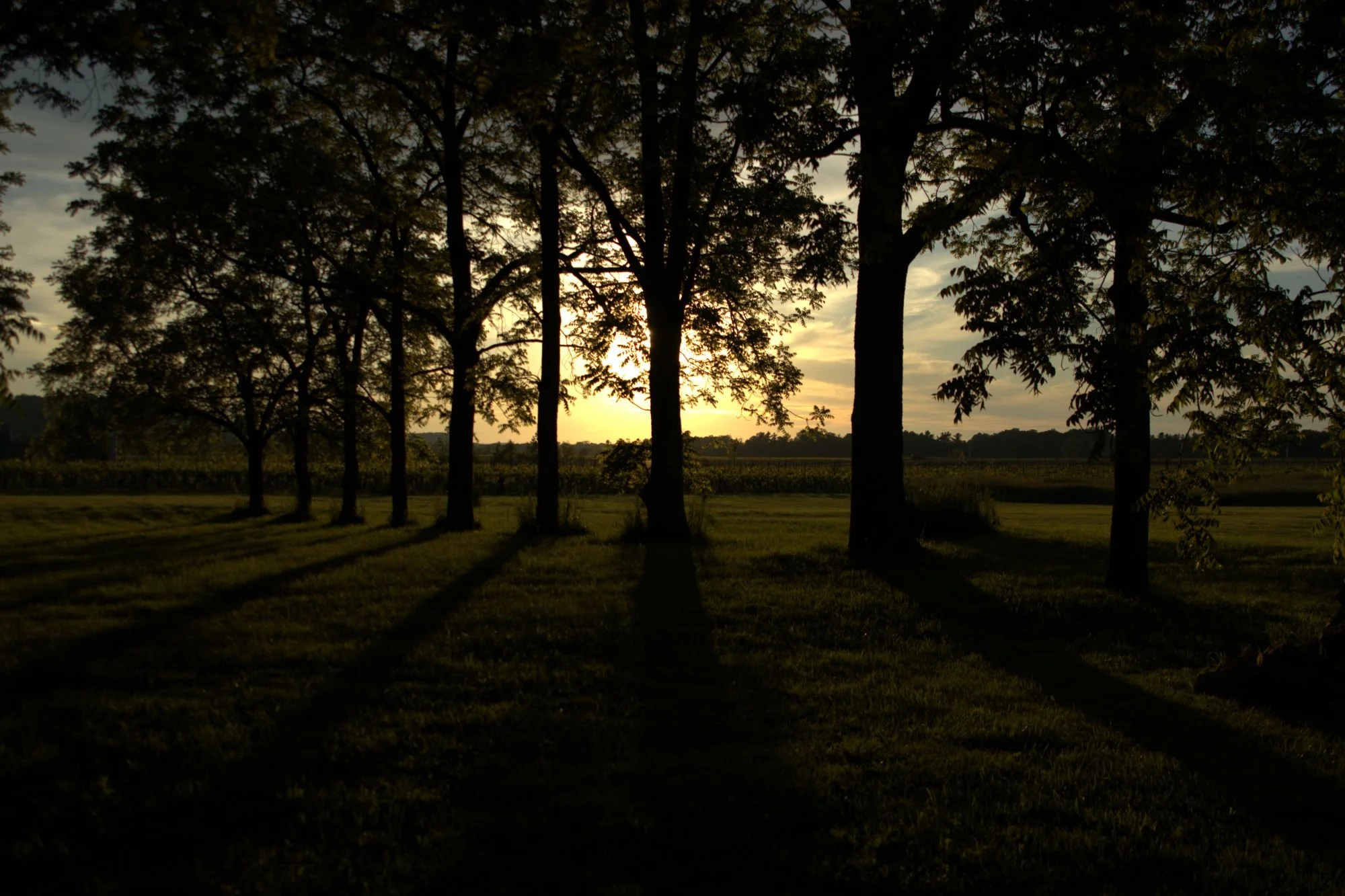
Come explore the pastoral grounds of The Brown Homestead! Bring a picnic, relax, and enjoy the view.
About the Author:
John R. Heckman is a public historian, writer, and doctoral student at Brock University. As the founder of The Tattooed Historian, he has spent more than a decade building community around accessible, emotionally honest public history. He regularly conducts livestream interviews with historians and authors on his YouTube channel, hosts live history-themed events in the local area, and writes a weekly Substack blog – The Tattooed Historian’s Dispatch – where he reflects on the practice of doing history in public and the responsibilities that come with it. He lives in St. Catharines with his wife and their spoiled cat.