

In the early 1870’s, a group of youngsters made their permanent mark on the John Brown House’s attic door and stairway. Who were these troublemakers? This summer, a few historic puzzle pieces came together during a particularly fruitful volunteer research session. Read on to learn more about young Newton Chellew, his local Pelham connections, and what they mean for our site. Who knows, maybe you can help us solve the mysteries of the attic door drawings!
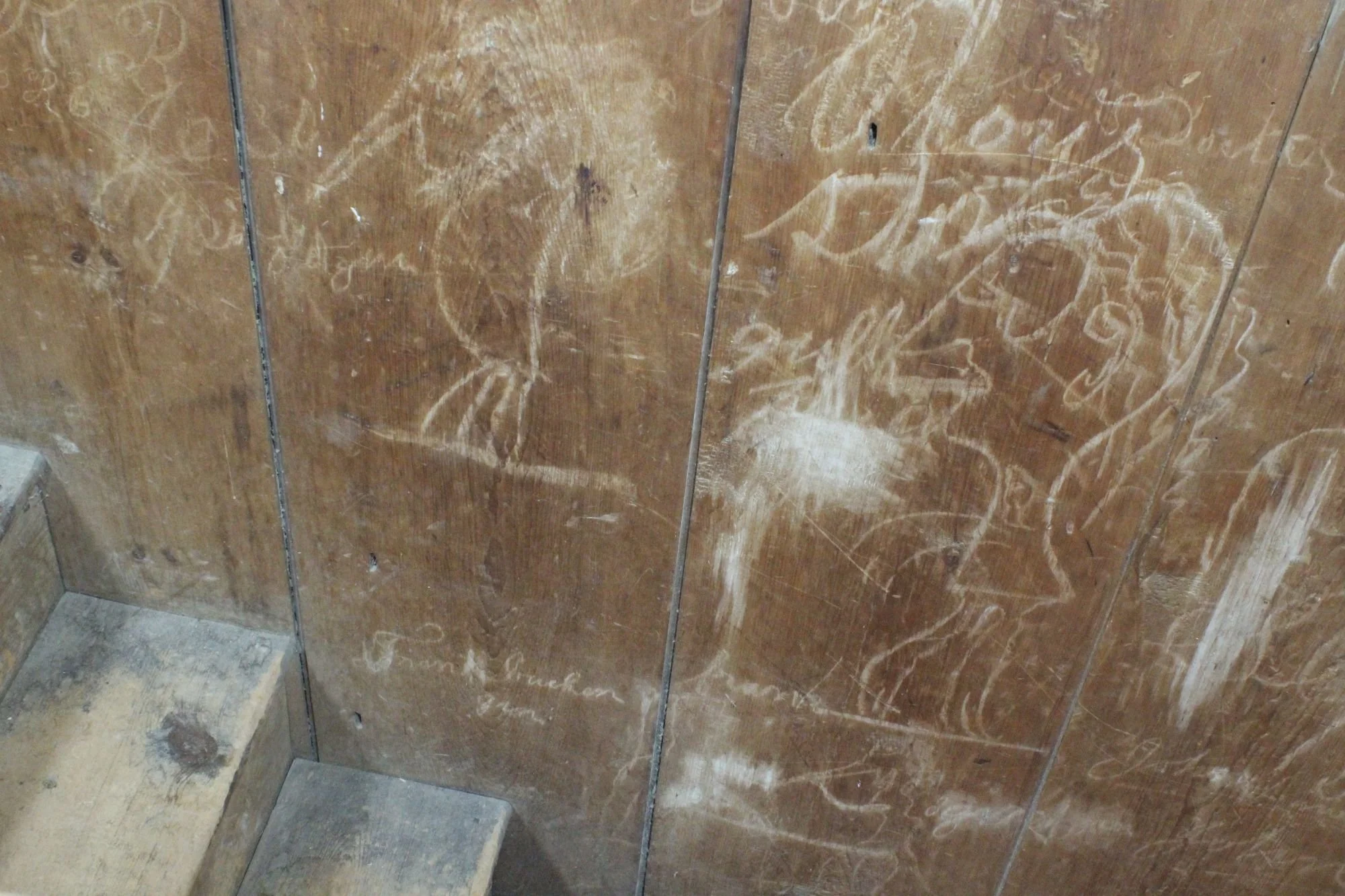
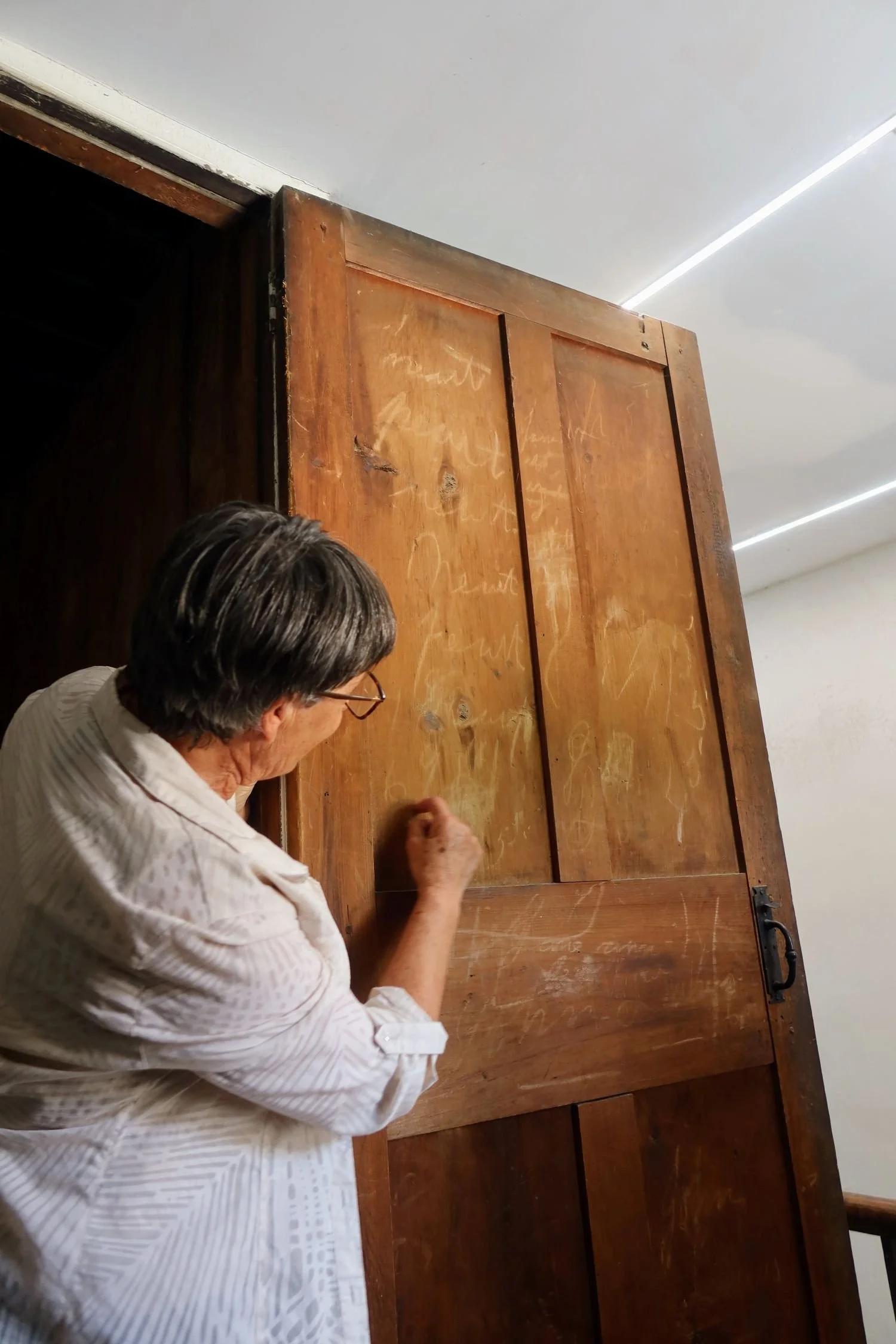
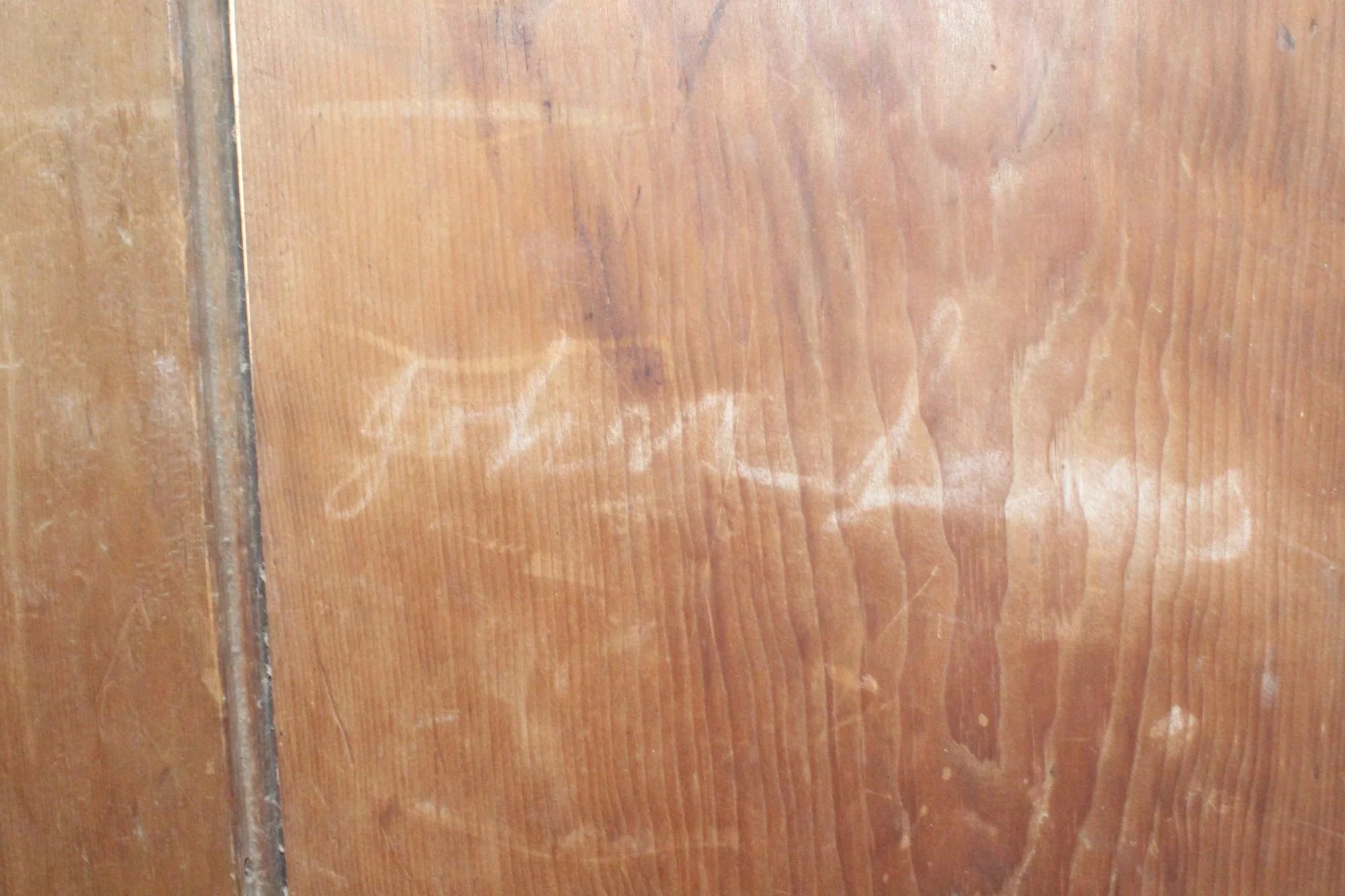
The inside of the attic door at the John Brown House contains curious markings from previous inhabitants.
This is a photo of the inside of the old door that leads up to our attic, here in the John Brown House.
When you look at this photo, what do you see? Can you make out any of the words?
Since we purchased this property in 2015, we’ve noted this feature as one of the John Brown House's many curious quirks. We have no information about what these inscriptions mean, who drew them, or when they were created. They are one of multiple instances of “graffiti” throughout the home.
In an exciting turn of events this summer, we believe we have solved part of the “Mystery of the Attic Door”.
Volunteer Research Discoveries
During one of our monthly volunteer researcher meetings, Diana Tracey updated the group about the research she had been conducting into the Chellew and Powers family genealogies, including mentions in local newspapers, and connections they had with surrounding schools, churches, and businesses. The Chellew family lived at The Brown Homestead between 1858-1902, and the Powers family from 1902-1979. Towards the end of the presentation, we broke out into more of a group conversation, and other volunteers spoke about some of the things they were learning in their own research.
Volunteer Diana Tracey presents her research at a group meeting in the John Brown House. June 2026.
Wanting to know more about what the inscriptions on the attic door and interior stairway paneling meant, volunteer Joanne Jones told the group about how she had recently captured a few high-quality photographs of the mystery markings. Because the stairway is poorly lit, these photographs would make it easier for researchers to zoom in on the inscriptions and conduct their investigations from home. The group was curious to see Joanne’s photographs, so we threw one of the images up on the big screen.
Immediately, everyone started shouting out what they thought the words said. We zeroed in on one word in particular. It was clearly being repeated, in a scrawling handwriting.
“Peart!”, “Pewt!”, “Newt!”... Huh? Newt? .. Like a salamander?
Wait a second! Having just worked with Diana on her Chellew family genealogical research, the name “Isaac Newton Chellew” flashed through my mind. She and I exchanged an excited look. Newt! That’s it!
Isaac Newton Chellew was born in 1861 and lived in the John Brown House until his late teens. The iconic name had gained popularity with the prestige of Sir Isaac Newton, reaching peak use in Canada around the 1880s. Ten-year-old Isaac appears in the 1871 Canadian census as “Newton Chellew”, which tells us that even as a young child, he went by “Newton” as his first name.
Who was Newton Chellew?
Newton was one of eleven Chellew children who grew up in the John Brown House. His parents Joseph and Eliza Chellew were British immigrants, coming to Canada in 1845 and purchasing land in Louth Township. They bought the 100-acre Brown Homestead property (Lot 3 Concession 8) in 1858 and built a brick smokehouse and dairy on site, thus broadening their access to different markets and sources of income on the farm in addition to the crops they grew. Newton would have helped his family grow and harvest their crops, care for the horses, milk the cows, herd and butcher the cattle, shear the sheep, chop firewood, repair faulty equipment, and any of the many other tasks one might perform on a 19th century Canadian farm.
The brick smokehouse and dairy pictured here, amongst other historic outbuildings
Newton’s choices as an adult indicate that farm life was not for him. By his early twenties, he had moved out to Illinois to join his older brother Joseph Jr., finding work at Davis Mills as a miller. He married Edith Evelyn Davis, the daughter of his employer, and they had a daughter named Ethel in 1888. Ever ambitious and future-focused, Joseph Jr. and Newton took advantage of the burgeoning industrial revolution and in 1889 they became principals of the Malmgren-Chellew Company, focused on general manufacturing. [1] Newton played the cornet, a brass instrument similar to the trumpet but with a more compact shape and a mellower tone. In fact, he was one of the organizers and the leader of the first Cornet Band in Glasford, Il. [2]
A snippet from the 1871 Census of Canada reflects data for the Chellew Family. Note Newton Chellew, age 10, on p. 29.
In 1887, Newton and Edith Chellew sustained serious injuries whilst on a train bound for Niagara Falls. The Great Chatsworth Train Wreck in Illinois was one of the deadliest U.S. rail accidents in the 19th century. More than one hundred passengers died and hundreds more wounded when their train passed over a trestle that had been weakened by a fire earlier that day. Newt suffered a dislocated hip, and both of Edith’s legs were broken.
Newton Chellew died from a cerebral haemorrhage in 1940, age 79. His obituary states that he was a respected citizen in Glasford, Illinois.
Embedded Memories
In typical middle child fashion, Newton often gets lost in the sea of youngsters that we discuss when we talk about the history of The Brown Homestead. Personally, I imagine a stampede of children running up and down the stairs and darting out the front of the house, bounding down the steps of the newly-built Victorian porch, and leaving the door wide open with Eliza calling out after them. Newton’s biographical details are a stark reminder of the fact that he was indeed, his own person. The etchings on the attic door now remind us of young Newt — a boy who left his mark.
“The memory of Isaac Newton Chellew is literally embedded in these walls.”
During his Homestead days, Newt had clearly gotten into some antics with his friends. Picture if you can, a group of boys huddled in the corner, snickering at the charicatures they were drawing in the attic stairwell. A closer look at the names on the door reveal that at least two other local youngsters, John and Frank, were part of the shenanigans.
Two other names appear, somewhat legibly, in the attic graffiti composition. “John Laws” shows up at least five times. Okay John… we get it!
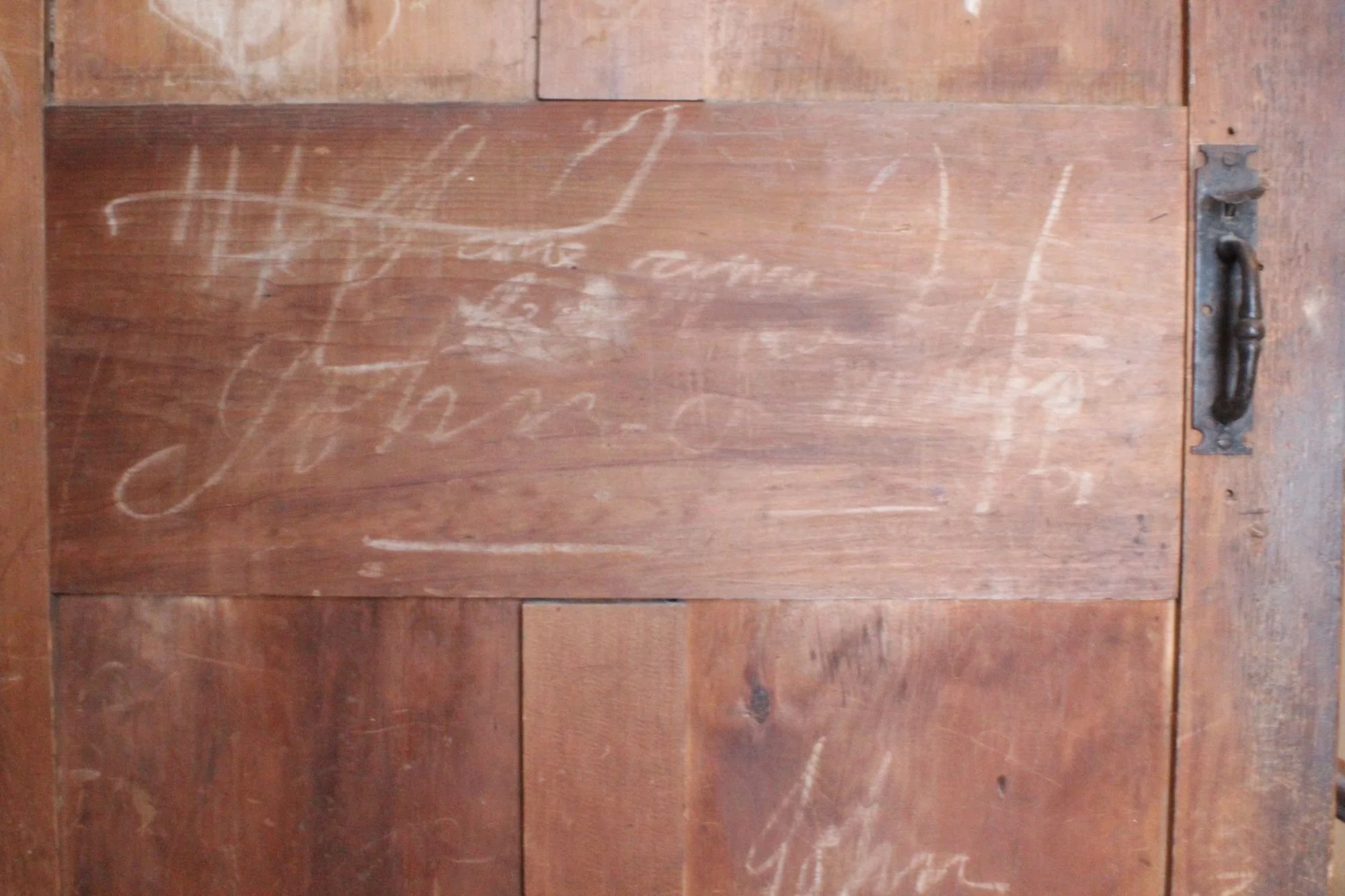
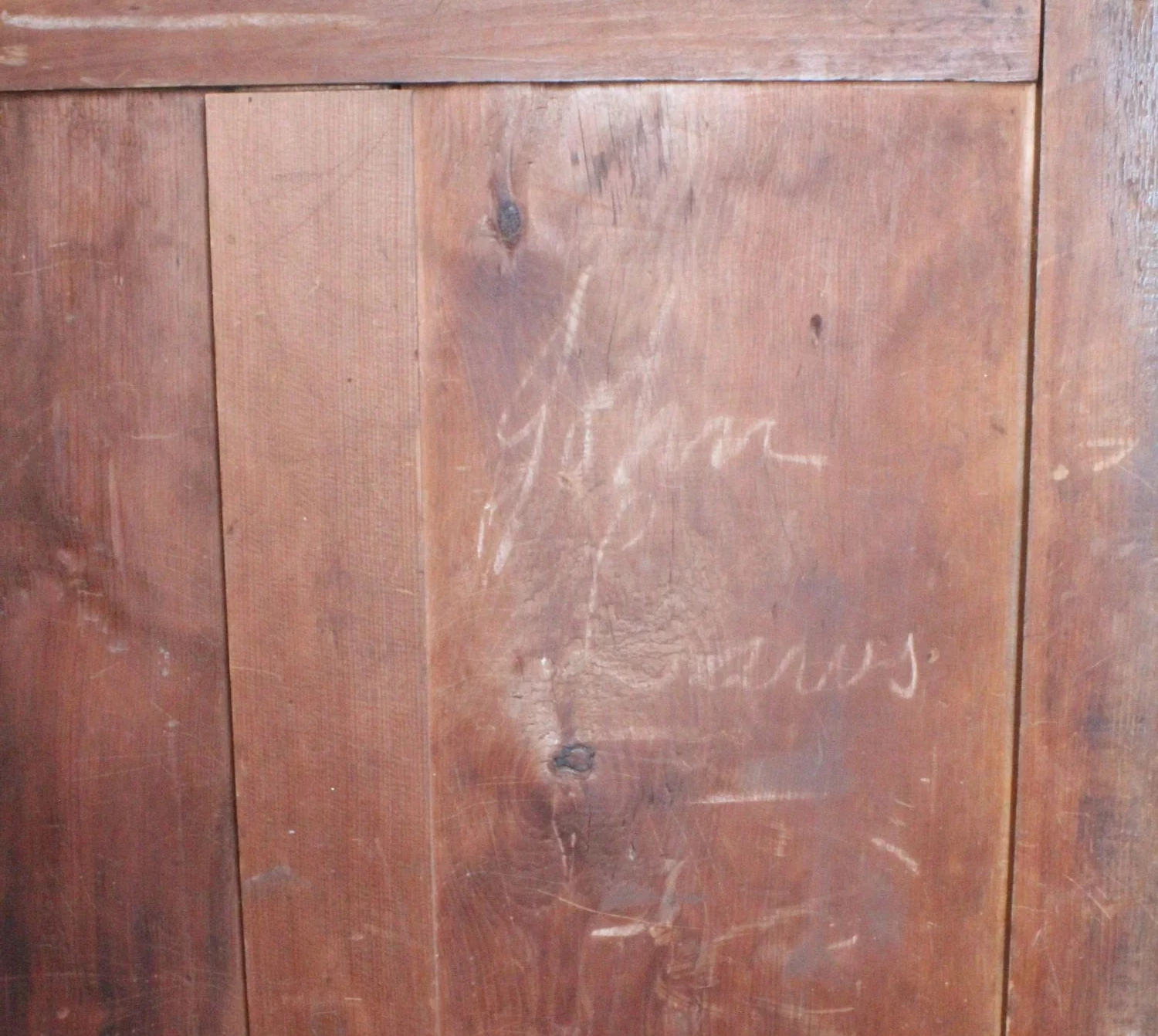
The Laws family is shown in Lots 5&6, Concession 3, Pelham Township, in the 1876 Illustrated Atlas of Lincoln and Welland Counties.
Our research leads us to believe that this was John Wilfred Laws of Pelham, who lived from 1857 to 1936. He was four years older than Newt, more likely friends with Newt’s older brothers Alfred (b. 1856) or George (b. 1858). John’s parents were Henry and Elizabeth Laws, farmers in Lot 5 Concession 3 in Pelham. This property is just 3 kilometres south of The Brown Homestead, near the intersection of Effingham Rd. and Roland Rd. Perhaps John spent 45 minutes trudging down through the Short Hills to get to the Chellew house, or maybe his parents dropped him off on their way into St. Catharines one day. Stories like these remind us that The Brown Homestead holds more than just the memories of those who lived in the John Brown House. So many other family members, friends, visitors, farm workers, and travelers have graced the halls of this home.
Unlike Newt, John Laws remained in Niagara. He and his wife Ella Cecilia Garner bought a farm in Thorold, and together they had four sons: Chester, Ray, Wilbur, and Earle. John passed away from a heart attack in 1936 at age 78 and is buried in the Niagara Falls Fairview Cemetery. [3]
Help us solve this mystery!
In the attic stairwell we see another name written in a clearly different hand. The first name is Frank, but we can’t quite make out the last name. What do you think? Frank Bucken? Guchen? Becker? Could it be a misspelling or alternate spelling of a local Pelham or Louth surname like Boughner, Burch, or Guinter?
When did this Happen?
Another important element to this research was figuring out the age of these drawings. The sprawling composition appears to have been drawn with the same material, however we are not certain of the boys’ writing utensil of choice. A close look does not reveal any sort of chalk or paint pigment. Rather, the markings appear to have been scratched into the wood. It could have been a slate pencil, or a similarly soft piece of limestone. After all, in the 1871 census, brothers Newton (age 10) and George Chellew (age 12), and John Laws (age 13) were all listed as “going to school”, and a 20-year-old schoolteacher named Allan Beckett actually lived with the Laws family at that time. [4] Beckett likely taught across the street at the one-room Laws’ School (S. S. No. 1 Pelham), located at 2502 Effingham Street near Roland Rd. [5]
The Laws family lived in Cayuga before moving to Pelham around 1870. For this reason, we attribute these drawings with an “early 1870s” date; the boys being anywhere between 9-15 years old. Who knows… maybe the young Chellew sisters Jane and Margaret were there as well, watching their older brothers gather around the attic door with John and Frank, cautiously observing the activity with a mix of excitement and apprehension, gasping as young Newt scrawled his name for all to see. Much of this is speculation, of course, but the puzzle pieces are slowly coming together. We expect to find more answers as we continue our examination of the drawings.
Conclusion
Some things never change. We wonder… did Newt get in trouble? Was it even him? Everyone knows the first rule of drawing on the furniture is to write your sibling’s name so you don’t get caught.
Next time you visit an old house, ask if they have any markings from the previous families. More often than not, you’ll see the children’s heights marked on a doorpost, a name carved into a floorboard, or the builder’s initials etched into a stud behind the layers of plaster. We have a few examples like this. After the Chellews, the next family to live at The Brown Homestead was the Powers family, who remained here from 1902 - 1979. Annie Powers carved her initials into the Master Bedroom door in the early 1900s, and her name appears alongside siblings Mabel and Charlie in the loft back when they used it as their play room.
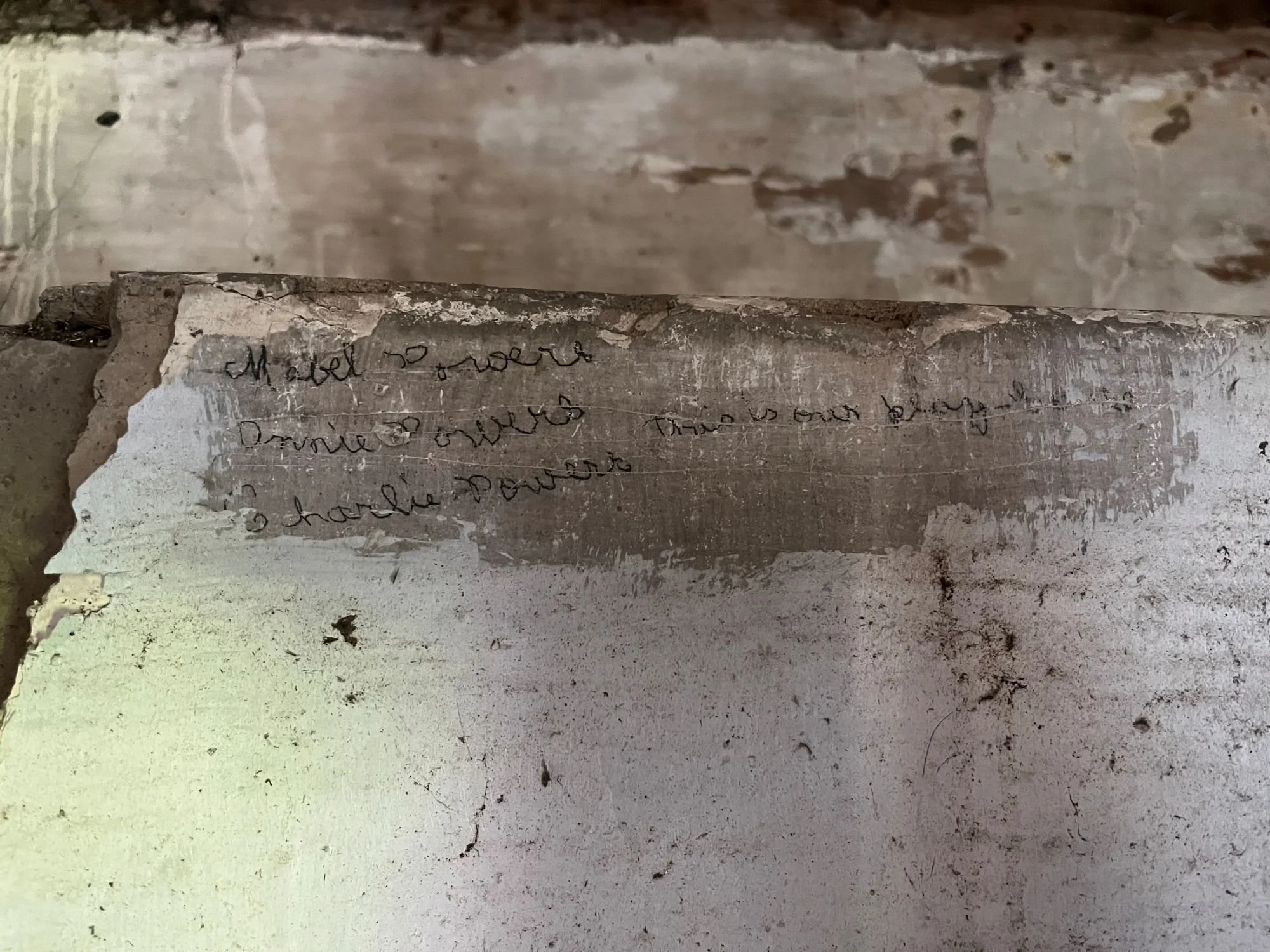
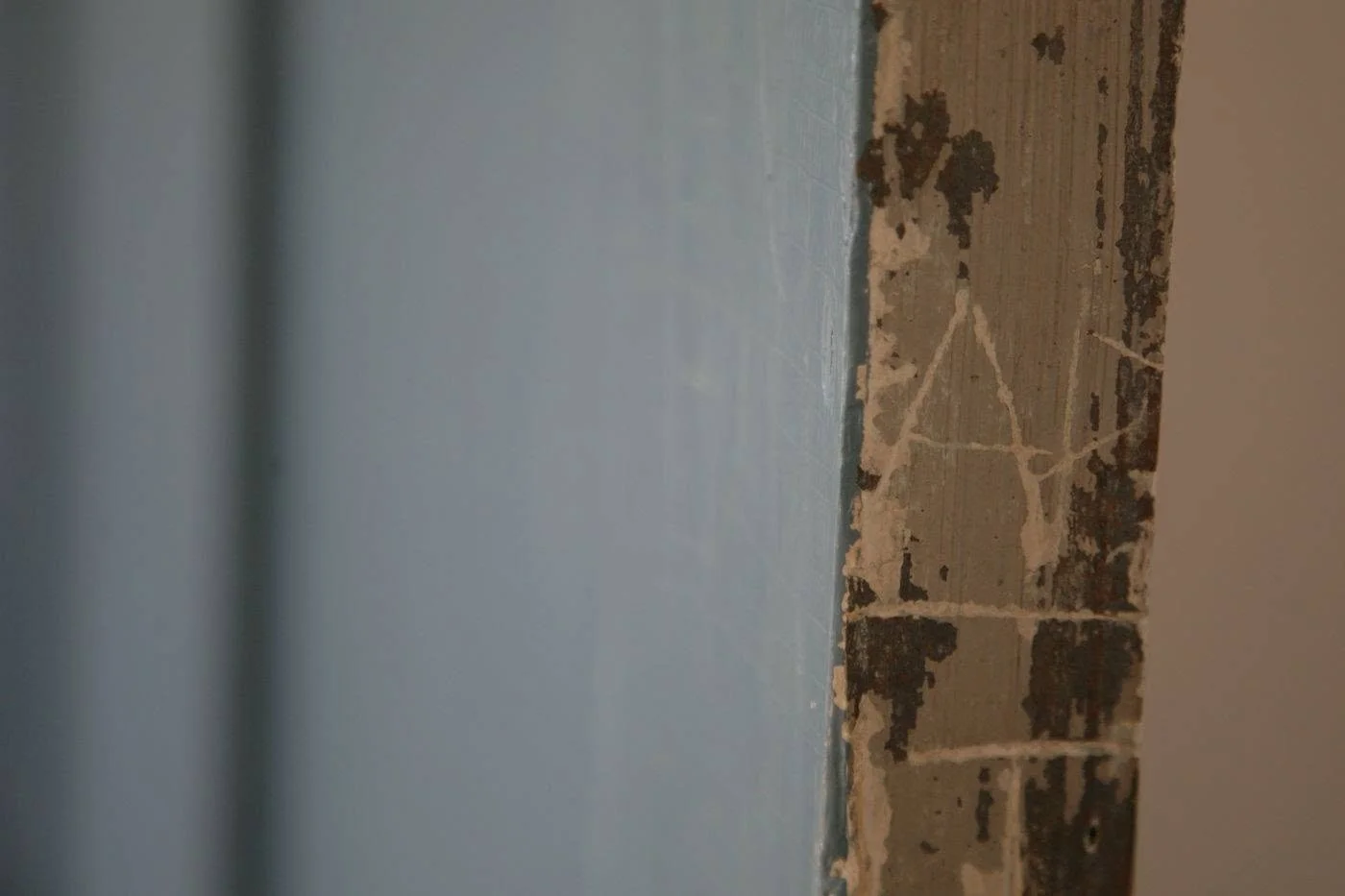
What about your family? What sort of “graffiti” exists in your home? Leave a comment below and let us know!
Jessica Linzel is a historical researcher and the Director of Research & Collections at The Brown Homestead.
Footnotes
Learn more about Joseph Chellew Jr. in “A Sociable and Unpretending Gentleman”. The Homestead Journal. March 20, 2020.
Genealogy Trails History Group. “Chellew, Isaac Newton”. Obituaries and Death Notices - C - Surnames.
“John Wilford Laws”. Ontario, Canada, Deaths and Deaths Overseas, 1869-1953. Ancestry.ca.
“John W. Laws”. Census Canada, 1871.
Pelham Historical Society. “Pelham Historical Calendar 1985: Laws’ School, S.S. No. 1, Pelham”. Pelham Historical Calendar Collection.